/


This is the long version of an article published in Le Figaro.
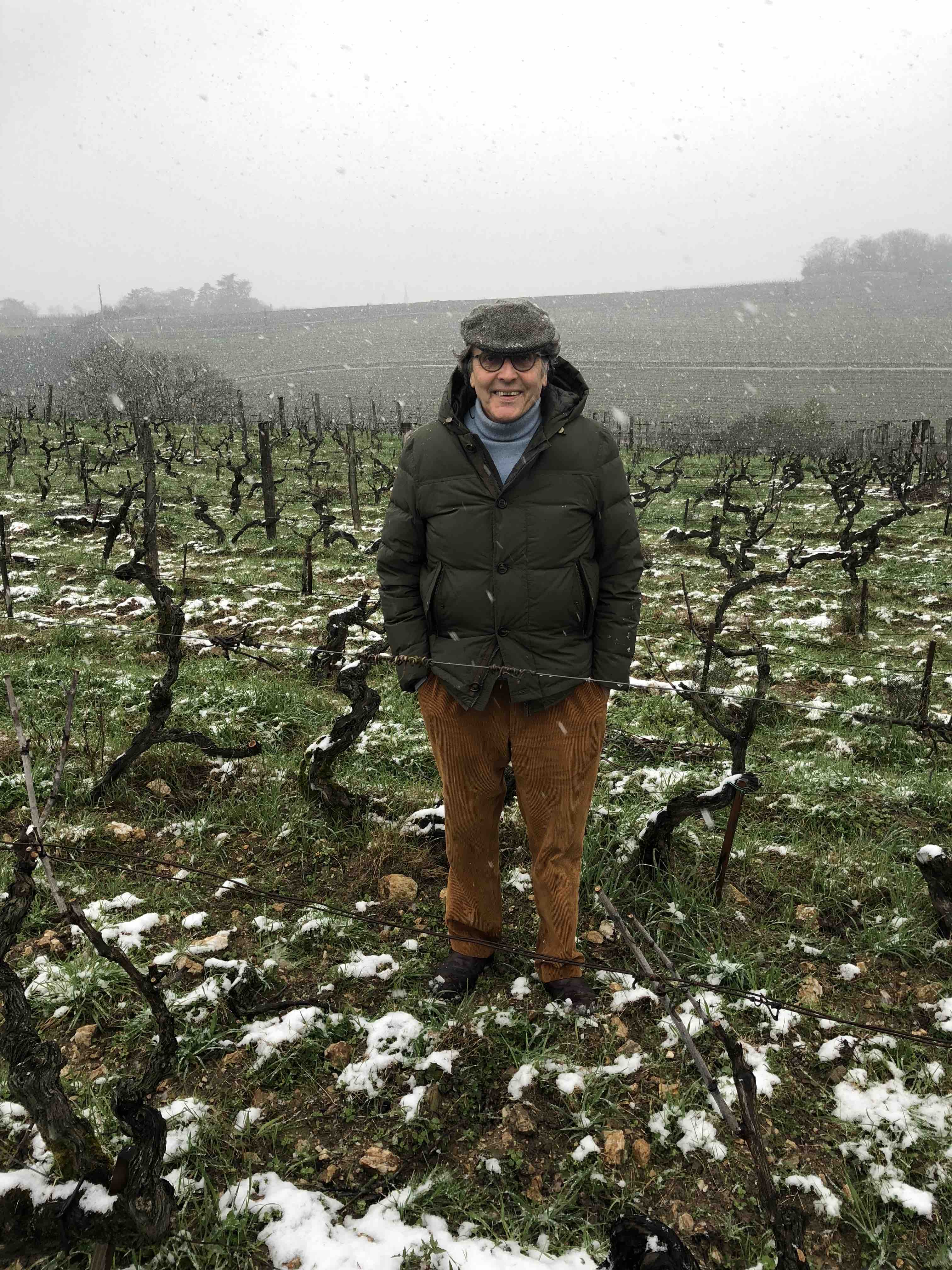
“To live happily, let’s live hidden.” This popular maxim could well be Emmanuel Reynaud’s. He is the owner of Château Rayas, the estate behind the iconic wine of the same name: a 100% Grenache Châteauneuf-du-Pape, distributed in tiny quantities to a handful of fortunate enthusiasts around the world, who vie for the rare bottles available only through allocation.
How long have you been at the head of Château Rayas?
It will be twenty years in January. Time goes by too fast. It has been in the family since 1880; my great-grandfather founded it, and my grandfather taught me everything. I take after him a lot, I think.
What makes Rayas’ terroirs so singular?
We are located in a shaded valley, on a north-facing slope. There is three times more woodland than vineyard. And above all, the soil: sea sand with no clay — clay helps retain moisture, and we have none — very poor soil, is the first element that makes Rayas unique. It yields very little. Depending on the year, our yields range from 5 hl/hectare to 15 hl/hectare. That’s part of the game, but it remains low. Some years it’s even very low. The ten hectares of vines used for Rayas are made up of three different types of sand.
How do these three sandy terroirs show up in the tasting?
The plots in the valley are those where the sand is the lightest. That is “the heart,” the most immediately legible part, which stands out in the first fifteen years of Rayas’ life. It’s the part that gives the most instant pleasure — at some point in your life, you may tend to prefer that. On the western side, the sand is denser, richer, more substantial: that is “the flesh” of our blend. On the eastern side, we have a sunnier soil with stones, warmer. We pick it earlier to keep freshness in the grapes. That will be “the skeleton” of the wine.
Which do you prefer?
The most severe part is the one I would prefer: the “skeleton,” which reveals itself after a long time. What matters above all is that the blend of the three is better than each taken separately. Making micro-cuvées is a real shame, because you skim something off. Compared to what? A journalist’s opinion, a personal taste? It brings nothing.
You insist on the ripeness of the fruit — is that where the magic happens?
Wine is very simple: it is the fruit of creation, and if we respect creation, it gives back to us. Any fruit picked ripe speaks — and speaks endlessly. Ripeness gives the fruit its length; the riper you pick, the more length of fruit you have. A fruit is naturally balanced, but you have to know when to seize it. In all our wines, what you taste is the purity of the fruit. They have no added aromas; there is no new wood, just old barrels, which have only one duty: to exchange with the outside so that the wine can evolve, age, and refine itself. Gradually it purifies through élevage, shedding what encumbers it — the fine lees — until only what matters remains: the fruit.
Your wines have extraordinary ageing potential. Does tasting old vintages of Rayas allow you to travel through time?
Yes, sometimes. What is crucial is to understand what the vintage wants to share. People often forget that. When you ferment grapes, you get a photograph. Each year you get the same photograph, but with different colours. You love a work of art, and whatever colour composes it, you must love it. It’s up to us to make the harmony of colours play out so that the year can express itself. There will be family resemblances, because they were born of the same lineage, but they are all different.
What is the photograph of 2015?
2015 will be a photograph in very intense colours. We will only touch the mystery of the vintage with time. It’s not the generation that makes it, but the next one that will be able to measure it. The story of an estate is the story of men. But a man is only passing through; it is the story of the place that must be transmitted, and remain in the same spirit. When I drink a 1978 or a 1929, I find it extraordinary — they still have things to say. There are years like that, that go very far.
What, in your view, explains people’s fascination with Rayas?
To understand Rayas, you have to accept the mystery of the place, the magic that comes out of it. We are in a privileged environment, protected by this valley; the woodland carries scents and protects the vines from heat as well as from wind. Vegetation starts earlier, but it takes longer to complete its cycle because it is sheltered. All these species create currents of scented air in spring, and currents of warm air in summer. The sand quickly regains its temperature after heat. It is sand that doesn’t stick. When you take it between your fingers, you feel that grain — the same grain you find on the palate when you taste Rayas. Our particularity is to make fresh wines, and for that you need a cool terroir — we need one more moon to ripen compared with others. We are not better; we are simply apart, because the place is apart.
Do you cultivate this mystery?
Inevitably. Naturally. Out of passion. First because there is always an interesting game to keep alive. Then because these are not wines made for everyone. They are so subtle — you have to make the effort to try to understand, to love a certain mystery. And we don’t have enough wine for everyone, so it is important for the estate to remain hidden.
Rayas has always been distributed through an allocation system. What kind of clientele do you favour?
There are people who drink wine to show off. We don’t want those clients. We like people who are passionate about beautiful things, good things. It’s essential to try to share with them. Wine isn’t made only for the rich; it’s made for everyone. That’s why we created Château des Tours (estate created in 1989, located 8 kilometres from Rayas, producing wines under the Vacqueyras and Côtes-du-Rhône AOCs — Ed.), to share our philosophy at a more accessible price. Money brings nothing. Passion brings something — as does the pleasure of sharing. That’s what I stand for.
And what kind of viticulture do you stand for?
I like wines made as simply as they can be made. Often it’s too contrived; people want to reach perfection, and sometimes there is make-up, or grapes that aren’t ripe. There are consultants and oenologists, and those people need to build in safety if they want to be recognised. The inevitable thing is that the wine ends up resembling the person. I think that’s natural. We have the capacity to carry what we can live — or cannot. I let time do its work; that’s difficult for many people. When people drink our wines, they often say they sleep well afterwards — but when you see what rises in the glass and on the palate, you tell yourself it’s normal that it makes the body feel fulfilled. You feel like you’re going to take off. There is a certain wisdom in them.
Do they make you wiser?
I don’t know. You’d have to ask my wife, but I don’t think she would agree (laughs). Even if, with time, you do have more philosophy — that’s for sure.
G.V.