/



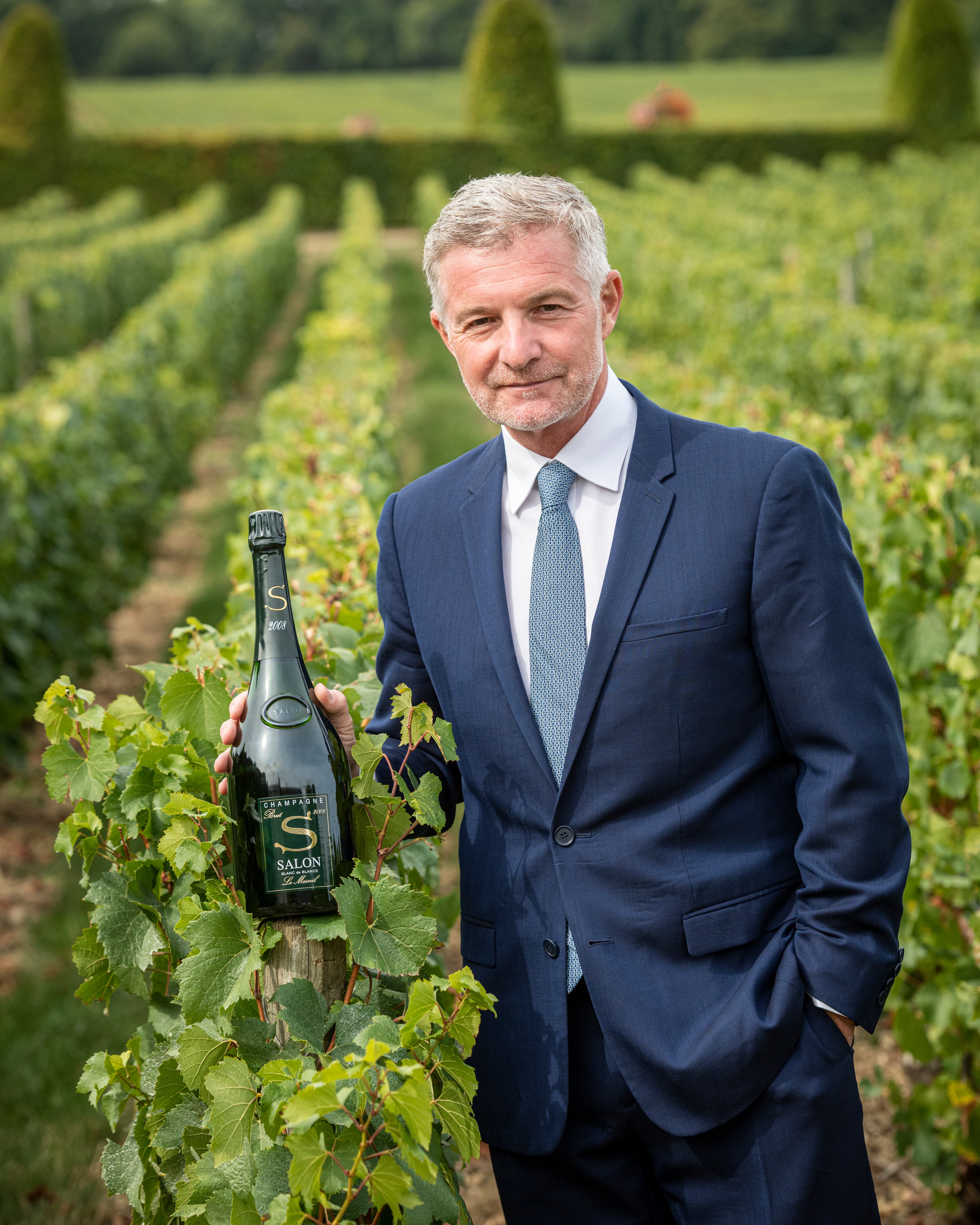
Created by Aimé Salon at the end of the 20th century, the house has risen to the status of a star. And like a star, it proudly asserts its choice to craft only a single champagne, made exclusively from Chardonnay grapes grown on six hectares of the grand cru of Le Mesnil-sur-Oger. With no blending, it is produced only in extraordinary years (in the 20th century, only 37 vintages of Salon were born). We are in the throbbing heart of the Côte des Blancs’ great terroirs, on the parcels above the church—as if to bring us closer to paradise. Salon is not owned; it is tamed, understood. Salon is not an apéritif champagne: it is savoured alongside the most refined dishes. A conversation about time with Didier Depond, director of Champagne Salon for 22 years.
Gabrielle Vizzavona: How does the notion of time come into play at Salon?
Didier Depond: Time is the very essence of the house—the spirit of the vines and the wines throughout the entire production process. We also understand time through the lens of the climatic year. Our eyes are fixed on the sky: everything we do in the vineyard depends on it and follows a precise calendar, shaped by old sayings such as, “Prune early, prune late—nothing beats pruning in March,” or “Thunder in April fills the barrels.”
GV: Why is it so important for Salon to give its wines the luxury of bottle ageing that exceeds ten years?
DD: We make only vintage champagnes, and not every year. In the 20th century, only 37 vintages were produced. At times we have gone five years without making any at all—few companies can afford that. It is a particular mindset: the price of rigour. Nature is generous, but it does not produce extraordinary things every year, and we want only the extraordinary. Part of our day-to-day reality is knowing when not to make wine. The ageing time of our bottles is dictated by the vintage, but for us it is a minimum of ten years; at present we are at twelve years of bottle ageing. We have fifteen years of stock in our cellars. It is a long-term vision you encounter less and less today, when everything is done to the minute. I make projections more than fifteen years out, like some Japanese companies that draw up hundred-year plans. Perhaps that is why Salon is so popular in Japan: we understand one another.
GV: You are going against the trend, which encourages wines made to be ready to drink more quickly?
DD: It is an economic issue. You need accessible, rounded wines. The vast majority of wines are made to be consumed quickly. We fully assume the ageing of our wines so that they are not drunk too early. We sell wines that are ready to drink, not primeurs. That requires the right financial foundation, determination, sound organisation—and above all, vision.
GV: What do such long ageing periods bring to your champagnes?
DD: The grapes we use come from the finest terroirs of the grand cru of Le Mesnil-sur-Oger; they have infinite vibrancy and minerality—very saline. The wines are very straight, clean and pure, linear in their youth. “Cleanliness” is a word I use constantly. Salon begins to be accessible when it is fifteen years old. Before that, it is a young mad dog. The 2002, for instance, is an adolescent. We will drink it with more pleasure, breadth and greatness in twenty years. At twenty-five years, Salon reaches adulthood. It follows human evolution, even if some vintages are more precocious than others—just as girls are more than boys! This extended ageing on lees helps to tame our wines, which are difficult to drink in their youth because of their power. This refinement allows us to round them out with time, not with sugar.
GV: Older vintages of Salon are striking for their pronounced notes of fresh bread, brioche and pastry. Is that the aromatic register you seek?
DD: Yes—in our case, that expression is pushed to its utmost. Alain Terrier, who was our cellar master and retired ten years ago, had an approach to wine shaped by his childhood in his parents’ bakery. It was rooted in him, and we would find those aromas in our wines as they aged.
GV: What is the ageing potential of Champagne Salon?
DD: It can go as far as eighty years and beyond. It is a paradox, because the current narrative is that champagne does not keep. In my view, the wines we make today will age better than those from fifty years ago. We have gained control thanks to technical progress, cleanliness in the cellar and the care given to the vines. All the conditions are in place for us to make wines that will be drinkable in a hundred years. One can easily draw a parallel with human life expectancy: like medicine, modern oenology gives wines a longer life. Our 2008, for example—which we release only in magnum—will not be for us, nor for our children, but for our grandchildren. You don’t identify a great man or a great woman in youth; it is over time that you see how people conduct themselves. The only definition of a great wine lies in its ageing potential.
GV: Are Salon lovers able to resist the temptation to drink their bottles too early?
DD: True enthusiasts—Salon collectors—wait for it like an event and know when they are opening a bottle too early. My clients generally own several vintages; today they are beginning to reach those from the 1990s. I think people know how to tell the difference, when you don’t deceive them. Our clients trust us; they know what we do, what Salon is, vintage after vintage—and they know me.
GV: Three words to define Salon?
DD: Rarity, elegance, rigour. Once, I compared the 1997 vintage to Audrey Hepburn—perhaps a little strict, but so elegant. Salon is not necessarily exuberant; it is not fashionable at all, but it is here for the long haul. It is the very expression of rigour, in the service of pleasure.
Salon 2007 opens with a delicately hazelnut- and anise-scented nose. The fruit is ripe, with subtle wafts of mirabelle plum and citron, marked by a dense mineral core perfumed with iodine and peat. The palate unfurls with richness and energy—full of bite, very creamy, precise and long—calling for superlatives. In these early years the wine is still full of youthful fire that time will transform: greater complexity, more pronounced pastry notes that are the hallmark of the Côte des Blancs’ greatest Chardonnays, and an even longer, more stretched finish.
GV